Actus
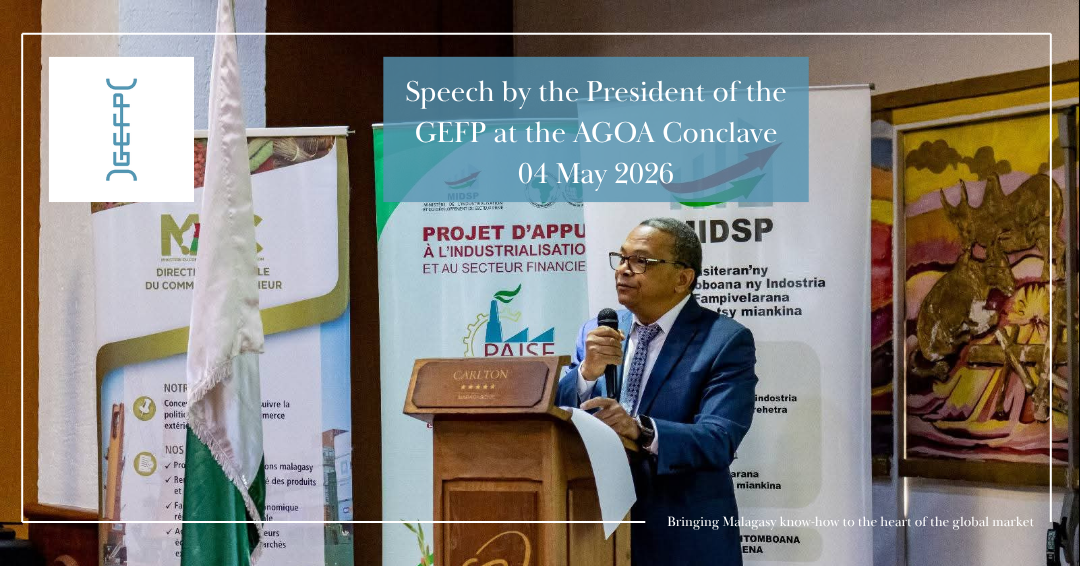
Speech by the President of the GEFP at the AGOA Conclave May 04, 2026
Mr. Prime Minister,
Honorable Ministers,
Distinguished guests in your respective ranks and positions,
It is with profound respect, and on behalf of all member companies of the Groupement des Entreprises Franches et Partenaires (GEFP), that I address this assembly today.
Mr. Prime Minister, allow me to first express the sincere and unanimous gratitude of the Malagasy private sector for your recent trip to the United States. Given the current situation, this was not merely a diplomatic trip—it was an audacious act. You carried Madagascar’s voice with strength, and the initial feedback following your meetings with members of the U.S. Congress is very positive.
A Context of Global and National Instability
As you know, our country is going through a very difficult period both politically and economically. External factors, such as the Iranian crisis, demonstrate how much Madagascar is at the mercy of global shocks, often without the means to respond to them.
The world and Madagascar are facing a period of major instability:
- Middle East tensions are disrupting global energy balances.
- The closure of the Strait of Hormuz poses a direct risk to logistics costs and supply chains.
- Major powers are reconfiguring their trade alliances.
- Most notably, the unpredictability of American political decisions creates permanent uncertainty for economic partners.
In this context, the recent one-year renewal of AGOA sent a positive signal, but it is largely insufficient. The global economy, particularly the textile sector, does not operate on a year-to-year basis; it operates on 3, 5, and 10-year cycles. Furthermore, the American electoral calendar adds pressure: by August 2026, the midterm elections risk freezing major decisions.
The Stakes for the Malagasy Textile Sector
Regarding the Malagasy garment sector, the current uncertainty surrounding the post-2026 renewal of AGOA is a major risk for the country’s political and social stability. Madagascar has already experienced a period of AGOA suspension, and no one has forgotten the damage it caused.
Recently, there has been much talk of parallel initiatives regarding AGOA renewal and others related to concluding a Reciprocal Trade Agreement (RTA) with the American government. We must honestly address the constraints of each:
- In both cases, Madagascar’s political situation complicates matters.
- We must simultaneously account for the global situation and the domestic political climate in the U.S.
- AGOA renewal and RTA negotiations are not competing choices, but likely successive necessities based on Madagascar’s return to constitutional order.
Before considering an RTA, we must recognize that AGOA eligibility is tied to governance and rule-of-law criteria. The USTR will be very vigilant, and it is crucial that Malagasy authorities provide reassuring signals. The 2027 eligibility review for Madagascar is scheduled to launch in the coming weeks.
The 2027 Social Risk
This leads to a critical deadline: July 2026. This is when international buyers, particularly Americans, place orders for future production cycles. Without clear visibility beyond 2026:
- Orders will not be secured.
- Volumes will mechanically decrease.
- Investment decisions will be frozen.
Simply put: the risk we carry today is a major social shock in 2027. Behind this risk are not just numbers, but 90,000 jobs, 90,000 families, and 360,000 lives. In the event of suspension, weighted customs duties on Malagasy clothing could double to 20% or more, leading to a complete halt of textile exports to the U.S. and the loss of 40,000 direct jobs.
Technical Realities and Competitiveness
The great advantage of AGOA is that it lacks reciprocity obligations, which would be required under an RTA. Another central provision is the « Third Country Fabric » clause. This allows Madagascar to use fabrics from Asia or Mauritius to manufacture duty-free clothing—a major operational advantage. Without it, the Malagasy textile industry cannot remain competitive.
We must be careful not to believe in the rhetoric of immediate vertical integration (Cotton-Spinning-Fabric). For over 20 years, the Chinese group Tian Li attempted to revive this sector with high ambitions, yet they only export a few thousand tons to Mauritius because Madagascar no longer has spinning capacity. Prohibitive electricity costs and heavy investment requirements are insurmountable barriers in the short to medium term.
Our Conclusion is Clear:
The maintenance of the « Third Country Fabric » clause in any evolution (like AGOA 2.0) or future RTA is a survival condition for the Malagasy textile industry oriented toward the American market.
Our Strategic Priorities
The priority for Madagascar, shared by the public and private sectors, must be:
- Secure AGOA renewal and resolve eligibility uncertainties immediately.
- Renew AGOA as a mandatory first step before engaging in more structured RTA negotiations.
To date, the U.S. administration has announced no official transition process toward RTAs for African countries. Furthermore, Madagascar’s political context makes such negotiations complex. While market opening and technical standards are not the main blockages, the model of the agreement is the true point of vigilance. A framework inspired by the Guatemala model appears far better suited to Madagascar’s industrial reality than models applied in Asia.
Finally, the private sector must be fully associated with these negotiations. Public-Private Dialogue must move beyond announcements and address sticking points, such as the reimbursement of VAT credit arrears. We need a climate of trust.
Conclusion: Our Ambition Remains Intact
Mr. Prime Minister, our ambition is to reach 250,000 jobs in the textile sector. This is an economic and social necessity. Madagascar has the assets: a skilled workforce, strategic resources, and recognized industrial capacity.
What we lack is not potential, but:
- Visibility
- Stability
- A long-term strategic framework
In an uncertain world, we cannot afford to wait. We must anticipate, structure, and speak with one voice. The GEFP is fully mobilized alongside the State to turn this uncertainty into a strategic opportunity.
« Without visibility today, there will be no activity tomorrow. And without activity tomorrow, there will be a social crisis the day after. »
Thank you.